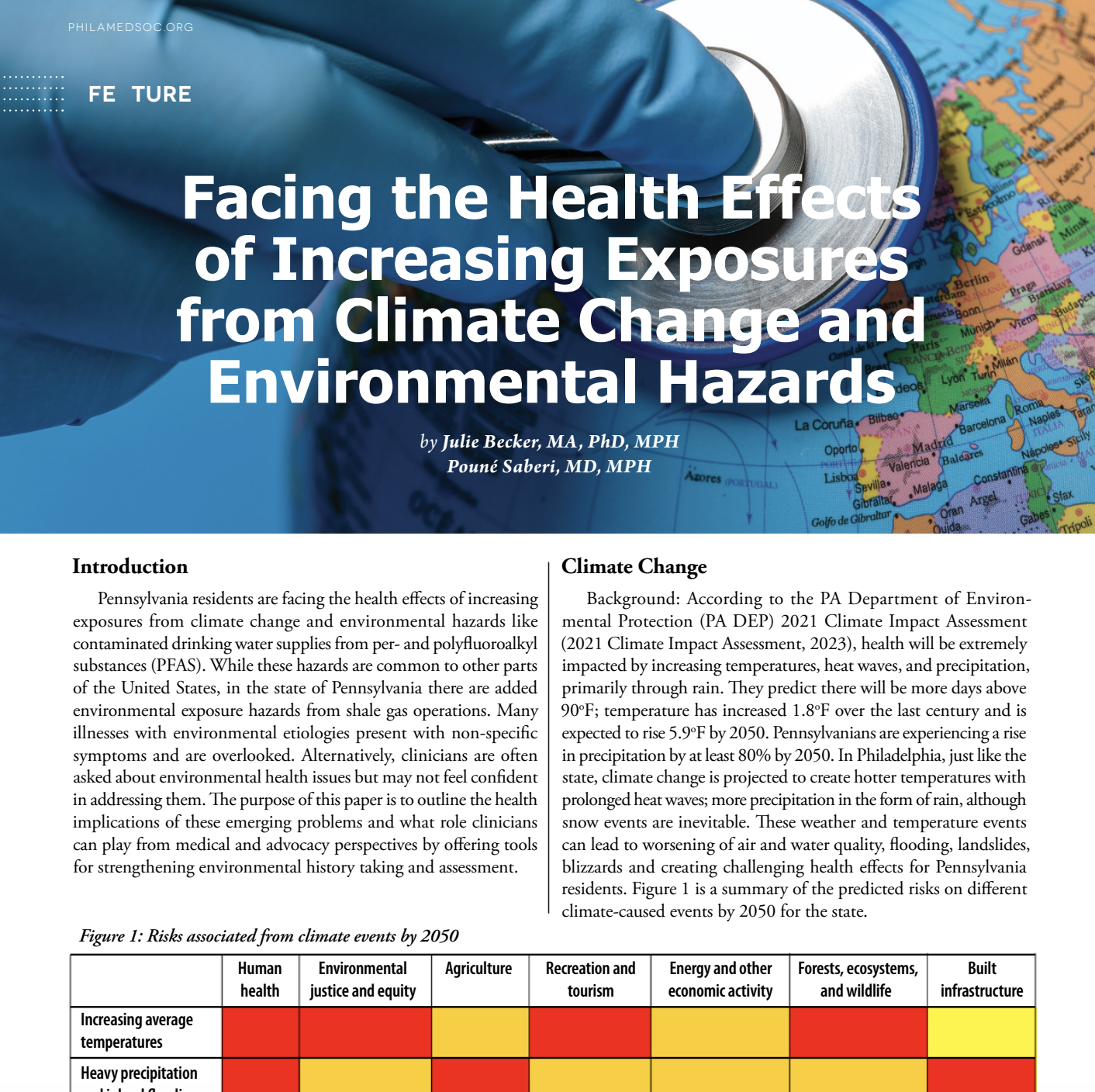
A listing of my various types of publications
Click on the image next to the short description to get the full article.
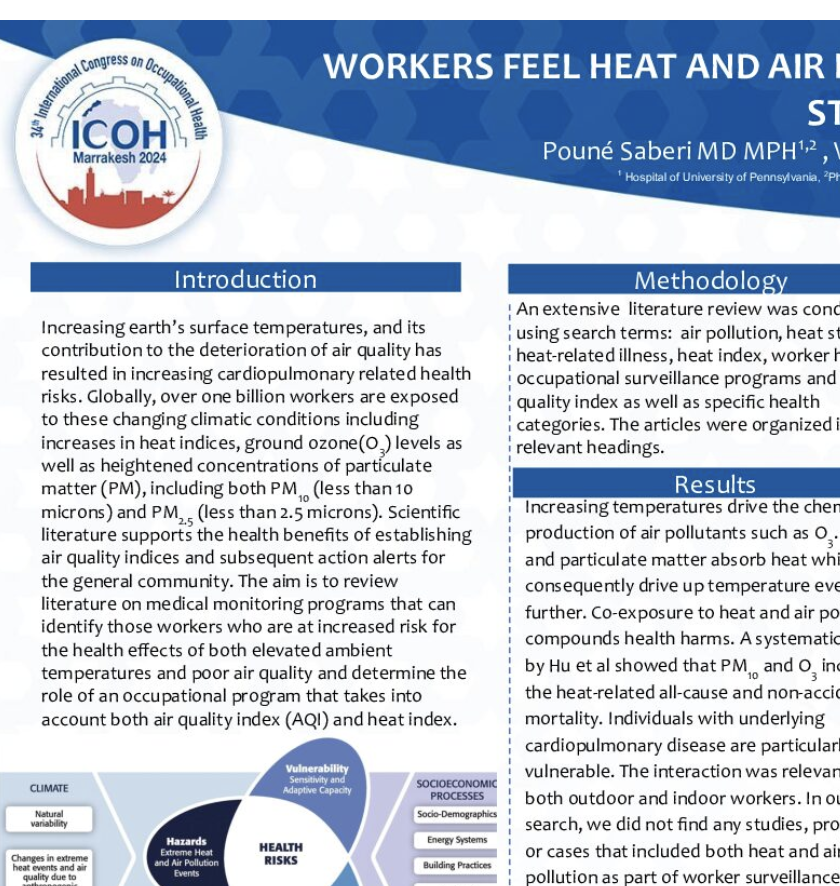
Poster presentation
Workers Feel Heat and Air Pollution: Expansion of the Role of Heat Stress Programs
Increasing Earth’s surface temperatures and their contribution to air quality deterioration have led to greater cardiopulmonary-related health risks. Globally, over one billion workers are exposed to these changing climatic conditions, including increases in heat indices, ground ozone (O3) levels, and heightened concentrations of particulate matter (PM), including both PM10 (less than 10 microns) and PM2.5 (less than 2.5 microns). Scientific literature supports the health benefits of establishing air quality indices and subsequent action alerts for the general community.
Letter to the editor
The Sustainable Energy Transition and Occupational Health
Major changes are occurring in the energy sector, with sustainable energy displacing conventional energy sources more and more. This appears to be driven today by market factors, but is also needed in order to curb the disastrous effects of climate change. What will this transition to ‘‘green’’ energy mean for occupational health risks in the energy sector? Answer: It will probably mean fewer big hazards, more small hazards, and an increase in falls from height. Seriously. Not to mention a better planet for workers to live on. We shall elaborate below.
Copyright © 2019 American College of Occupational and Environmental Medicine
ACOEM GUIDANCE STATEMENT
Addressing Environmental Health
Clinician Training and Practice of Environmental Medicine—ACOEM
Guidance Statement
In this guidance statement, the American College of Occupational and Environmental Medicine (ACOEM) Section on Environmental Health explores the role of occupational and environmental medicine (OEM) clinicians, comprising both physicians and advanced practice providers, such as nurse practitioners and physician assistants, in addressing environmental health concerns in both clinical practice and prevention policies. It also discusses emerging environmental occupations, clinical competencies in environmental medicine, and careers in environmental health.
ACOEM GUIDANCE STATEMENT
Responsibilities of the Occupational and Environmental Medicine Provider in the Treatment and Prevention of Climate Change-Related Health Problems
Workers are uniquely susceptible to the health hazards imposed by environmental changes. Occupational and environmental medicine (OEM) providers are at the forefront of emerging health issues affecting working populations, including climate change, and must be prepared to recognize, respond to, and mitigate climate change-related health effects among workers. This guidance document from the American College of Occupational and Environmental Medicine focuses on the health effects on North American workers that may result from climate change and describes the OEM provider’s responsibilities in responding to these health challenges.
Copyright © 2017 American College of Occupational and Environmental Medicine.
ORIGINAL ARTICLE
Interactive Workshop on Identifying Health Effects of Climate
Change in the Clinical Setting
An Occupational and Environmental Health Solution
Objective: The aim of the study was to provide clinicians an occupational framework to assess climate-related health conditions, determine at-risk workers, and devise solutions. Methods: An interactive workshop was presented at the 2022 American Occupational Health Conference. Six climactic events related to occupational health were chosen with corresponding cases from the National Institute of Environmental Health Sciences. Participants answered and discussed scripted questions. A 5-point Likert scale utilized by the American Occupational Health Conference evaluated the workshop’s quality and utility, and the audience’s ability to apply the knowledge. Results: Sixty-one (N = 66) participants ranked the workshop highly (4.4–4.6/5). Most participants (90%) reported incorporation of practical knowledge gained, increased advocacy capacity, and the ability to teach about the issue. Conclusions: Successful integration of engaging, interactive sessions into clinician education on climate change and health is critical, as climatic conditions can increase patient vulnerability in their roles as workers.
ACOEM GUIDANCE STATEMENT
Facing the Health Effects of Increasing Exposures from Climate Change and Environmental Hazards
Pennsylvania residents are facing the health effects of increasing exposure to climate change and environmental hazards, such as contaminated drinking water supplies from per- and polyfluoroalkyl substances (PFAS). While these hazards are common across other parts of the United States, in Pennsylvania, there are additional environmental exposure hazards from shale gas operations. Many illnesses with environmental etiologies present with non-specific symptoms and are overlooked.